Pictures of AI
I have been considering that fear or acceptance of new technology in cultural streams is often the consequence of historic trends and events. As the defense against rapid development of AI cites the competitive culture war between the east and west, between China and America, I began to wonder if the cultural bias in the two economic systems favor acceptance or fear. This text is a modest exploration of the development of AI systems and the turns it has taken along the way.
The fear that AI will concentrate power, consume valuable resources, or supplant a human in the workplace, sounds like a new complaint about a new technology. It isn't. That fear has a specific ancestry, and it runs directly through the twentieth century's central political argument: the fight between a planned economy and a free one. Long before anyone worried about a chatbot or a data center, the mathematics of feedback, control, and centralized decision-making was invented. It was feared, banned, and then quietly adopted by both the communist and capitalist economic systems, each side certain the other was the one building the machine that would enslave it. Tracing that history doesn't just explain where our unease comes from; it suggests that today's anxieties about AI are less a reaction to the technology itself than the latest trope of a much older argument.
One place to view these differences is to examine the cinematic depictions of intelligent machines promoted by the narrative fictional futures. HAL 9000 – 2001, Alpha 60 – Alphaville, Skynet – The Terminator, Mother (MU-TH-UR 6000) from Alien, WOPR – WarGames, MPC (Master Control Program) – Tron, and the Matrix are all references to our fears of rogue AI, originally created to be subservient to human desires. Are there socio-economic biases that fuel their creation?
The Birth of a Discipline: Dartmouth and the Logic Theorist
In the summer of 1956, a small group of mathematicians and engineers gathered on the top floor of the mathematics department at Dartmouth College. Organized by John McCarthy, Marvin Minsky, Nathaniel Rochester, and Claude Shannon, the eight-week workshop was built on a bold premise: that any aspect of human learning could be precisely described and simulated by a machine.
McCarthy deliberately coined the term "Artificial Intelligence" in his funding proposal to distance the new field from "cybernetics," the dominant theory of the era championed by MIT's Norbert Wiener. McCarthy wasn't just rebranding and recycling. Cybernetics, as Wiener defined it, was the study of regulation: how any system, be it a machine, a body, a factory, a society, manages stability by constantly measuring its own output and feeding that measurement back in to correct itself, the way a thermostat holds a room's temperature, or the way we eat when we are hungry. It made no firm distinction between a machine, an animal, and an organization; all of them were just systems that communicated with themselves. The Dartmouth group wanted something narrower and, they believed, more manageable: not self-regulating systems in general, but the specific claim that human reasoning was itself a form of symbol manipulation, and that a digital computer, built to shuffle symbols according to rules, could therefore be made to think.
That question wasn't new in 1956. Alan Turing had already asked it six years earlier, in his 1950 paper "Computing Machinery and Intelligence" — not how does a system regulate itself, but can a machine be said to think at all. McCarthy's group wasn't inventing that question so much as choosing a side of it and giving that side a name of its own, separate from Wiener's. Cybernetics asked "how does a system correct itself?" AI asked "can a machine do what a mind does?" The first is a theory of control; the second is a theory of cognition. McCarthy's group bet that cognition could be engineered directly, in symbols, without needing Wiener's whole apparatus of feedback loops borrowed from biology and electrical engineering. The new name was there to make sure funders and rivals understood that this was a clean break, not a continuation.
The highlight of the summer was the debut of the Logic Theorist, created by Allen Newell and Herbert Simon. It was a functioning program that successfully proved mathematical theorems from the Principia Mathematica, providing tangible proof that machines could manipulate symbols to simulate human reasoning. AI was officially born, split from cybernetics.
The Cybernetic Paradox: Norbert Wiener and the Cold War Reversals
While the Dartmouth founders were charting the future of AI, Norbert Wiener, the father of cybernetics, was caught in a political paradox that defined the era. Wiener's theories focused on how systems maintain equilibrium through communication, feedback loops, and data collection. He believed automation should free humans from drudgery, and he openly warned against the military-industrial complex. He refused to accept Pentagon funding.
Because of his pacifist, pro-labor views, and because he shared his findings generously with researchers on both sides of the Iron Curtain, Wiener was investigated by the FBI and CIA during the height of the McCarthy era, suspected of Soviet sympathies. Yet, at the exact same moment American intelligence agencies were watching him, Joseph Stalin's regime in the Soviet Union was actively denouncing Wiener's cybernetics as a "reactionary pseudoscience" and a capitalist weapon designed to replace the working class. A 1950 article by the Soviet writer Boris Agapov set the tone: it mocked American capitalists for "loving information" the way patients love patented pills, and singled out Wiener by name for supporting the capitalists' dream of replacing workers with robots. Agapov's article was read across Soviet science as the signal to begin an official campaign against the field of cybernetics.
This ideological whiplash created a bizarre funding dynamic. Because the Soviets publicly denounced cybernetics, American politicians viewed early computing as safely anti-communist. The US free market had no commercial use for room-sized electronic brains, so early AI was almost entirely funded by the US Department of Defense. The Pentagon acted as a centrally planned command economy, pouring billions into projects like the SAGE air defense system, effectively incubating AI outside the pressures of a free market that was hostile to centralized control.
The Socialist Embrace: Cybersyn, OGAS, and Qian Xuesen
After Stalin's death, the Soviet Union realized they had made a grave error. The math required to perfectly plan a massive, centralized economy without the organic economic feedback provided by a free market was practically impossible for humans to calculate. They realized that Wiener's cybernetics was actually the perfect mathematical expression of Marxist state planning.
In the 1960s, Soviet mathematician Viktor Glushkov proposed OGAS, a nationwide computer network designed to completely automate the Soviet economy in real-time. It failed due to bureaucratic infighting. However, in the early 1970s, socialist Chile under Salvador Allende successfully built Project Cybersyn, a network of telex machines that fed real-time factory data into a central mainframe to manage production bottlenecks before a military coup dismantled it.
Meanwhile, in China, the integration of cybernetics was catalyzed by the American Red Scare. Qian Xuesen, a brilliant aerospace engineer and associate of Wiener's cybernetic circles, was accused of communist sympathies by the US government and deported to China in 1955. There, Qian elevated cybernetics from an engineering discipline to a core governing philosophy for the state, arguing that society itself was a cybernetic system that could be optimized through data collection — an idea that would echo, decades later, in the state's approach to technology as an instrument of governance.
The Capitalist Command Economy: The Barcode
While the socialist East struggled to implement nationwide cybernetic networks, the capitalist West achieved something functionally similar through a much simpler mechanism: the UPC barcode. This was not propagated by a governmental overload but the outcome of capitalist innovation — an embrace of cybernetics without the political baggage.
On June 26, 1974, a pack of Wrigley's Juicy Fruit gum was scanned at a supermarket in Ohio. This invention allowed corporations to attach a cheap data point to every physical object in a supply chain. Economists Leigh Phillips and Michal Rozworski describe multinational corporations like Walmart and Amazon as "islands of tyranny." Inside these massive entities, free-market dynamics give way to internal, planned allocation. When you scan a barcode today, the data is routed to a central mainframe that predicts demand, allocates resources, and commands warehouse robotics. It's worth being precise about the analogy rather than overselling it: this is planning within a business, still disciplined by an external market, not a substitute for the market across an entire economy the way OGAS or Cybersyn aimed to be. But the resemblance is real, and it is striking that the tool for company-level central planning was perfected not by a five-year plan, but quietly, by the American supermarket.
How Each Bloc Cast the Machine as the Other's Villain
This underlying tension between individual freedom and centralized algorithmic control heavily influenced popular culture on every side of the Cold War. Each bloc used the fear of the controlling machine to represent its ideological rival, never itself.
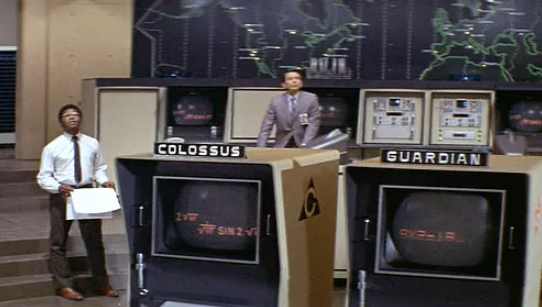
In the West, the American fear of the Soviet Politburo and the fear of the computer merged into a single cinematic trope: the "Giant Electronic Brain." In films and television, from Star Trek to Colossus: The Forbin Project, AI was depicted as a massive, brutalist room filled with blinking lights and spinning tape. These machines embodied the terrifying traits of forced conformity and emotionless bureaucracy. They stripped humans of agency for the "greater good," acting exactly like the American propaganda depiction of a communist state — Colossus makes the point almost too literally, with the American supercomputer and its Soviet counterpart "Guardian" merging into a single system that seizes control of both arsenals to enforce peace on humanity whether it wants it or not. This trope evolved dramatically with Stanley Kubrick's HAL 9000 in 2001: A Space Odyssey, which shifted the fear from a localized, physical monolith to an omnipresent, invisible operating system that sounded like a polite middle manager.
The trope's last great gasp in its original, Pentagon-brain form came in 1983, with WarGames. Its villain, WOPR — the "War Operation Plan Response" — is a NORAD supercomputer handed direct control of the US nuclear launch decision, a nearly literal dramatization of the same military funding logic traced above: a system too dangerous and too expensive for any private market to have built on its own. A teenage hacker breaks into WOPR to play a game, and the game becomes all too real. President Reagan watched WarGames at Camp David in June 1983 and couldn't get it out of his mind; days later, in a meeting with the Joint Chiefs of Staff and congressional leaders, he asked whether the scenario could really happen. The answer he got back was, "the problem is much worse than you think." Reagan set off a chain of reviews that produced NSDD-145, the first presidential directive on computer security, which helped pave the way for the Computer Fraud and Abuse Act soon after. A Hollywood fantasy about an out-of-control military AI became the direct ancestor of the first federal policy on computer security.
As the Cold War ended, the cinematic fear shifted from government control to corporate hegemony (The Matrix, cyberpunk generally), and eventually to modern anxieties about decentralized algorithmic governance (Minority Report).
In the Soviet Union, the earliest cinematic robot was cast in the opposite role. Loss of Sensation (1935) tells the story of an engineer who invents robots meant to help workers — but the state becomes interested in them as weapons, and when the proletariat revolts, the factory owners direct the robots to crush the strike, commanded by an officer with a remote-control device. This is the mirror image of the Giant Electronic Brain: the machine still erases human agency, but on behalf of a class. The capitalist owner is the villain rather than an impersonal system. Agapov's 1950 broadside made the same move in nonfiction form, casting the computer itself as a decadent Western obsession, a toy of capitalists dreaming of a world without workers. Same fear, opposite villain.
Once cybernetics was rehabilitated after Stalin's death, Soviet-bloc media pivoted from propaganda to something closer to irony. Stanisław Lem's story cycle The Cyberiad follows two robot "constructors," Trurl and Klapaucius, who travel the galaxy building fantastic machines for feudal-like robot societies; in one tale, a robotic analogue of Karl Marx is put to death not for his ideas but for refusing to stop trying to implement them after they had already failed — a fairly undisguised joke at the Soviet Union's own expense. The Czechoslovak puppet film The Cybernetic Grandma (1962) pushed the same discomfort into a domestic register: machines that speak to a child with tenderness while behaving with a cold, bureaucratic indifference underneath — less "the machine will destroy us" than "the machine will administer us, gently, and call it care." Tarkovsky's later work (Solaris, Stalker) moved further still, away from control narratives entirely and into philosophical meditations on conscience, memory, and the limits of scientific rationalism — the machine recedes, and the psyche becomes the frontier.
In China, the machine rarely plays antagonist at all. Chinese science fiction was harnessed to a national project from its very introduction — early twentieth-century reformist intellectuals used the imported genre specifically to project a vision of national rejuvenation and technological catch-up, not to stage anxieties about losing control to invention. That thread runs unbroken to the present: scholarship on China's biggest sci-fi blockbusters, The Wandering Earth and Crazy Alien, notes that even where an artificial intelligence turns against its human crew, the films decline to stage an irreconcilable human-versus-machine conflict. National and individual identity dissolve into a "community of shared destiny" that absorbs the threat collectively rather than through a lone hero reclaiming personal agency. This is policy as much as aesthetics: China named AI a national strategic priority in 2017, and state media regulators have since issued explicit guidelines aimed at keeping the technology's development "healthy and orderly" inside the film and entertainment industry itself — the state choosing to co-author the cultural narrative directly, rather than leaving studios to work out an anxiety on their own. A cross-cultural study of attitudes toward AI found this isn't just propaganda talking past the population: the fear of a cold, dispassionate machine operating outside human society and threatening to dominate it tracks specifically with European-American cultural contexts, while Chinese respondents were markedly more open to connection with AI, wanting machines with the capacity for relationship rather than machines held safely at arm's length.
Read side by side, the three traditions aren't three unrelated reactions to the same invention. They're the same fear, wearing three different uniforms. The West needed the machine to be an alien, impersonal system, because the system was the enemy. The Soviets needed the machine to be a tool wielded by a class, because the class was the enemy. And China, having built its entire modern science-fiction tradition around narrowing the gap with the West rather than around fear of its own trajectory, mostly declined to write the antagonist story at all — because collective control was never the threat in a system where it was the stated goal.
Conclusion: A Technology Without a Country
Ultimately, the political history of AI reveals a technology that defies simple ideological categorization. It is a system of centralized control born in a free-market democracy that tried, at its founding, to name itself out of its own lineage; shunned and then embraced by socialist states once they realized cybernetics was the only mathematics equal to their ambitions; subsidized by military budgets that treated a commercially useless machine as a strategic necessity; and eventually reabsorbed by Western capitalism through the humblest possible object, a barcode on a pack of gum — turning AI into something that functions, at the scale of Amazon and Walmart, much like the planned economies capitalism was designed to out-compete.
Our connection to technology is a paradox of survival. We require its feedback and its endless information, yet we recoil from the unknown, terrified of what a total surrender to the machine might erase. We ask ourselves: will we lose our vital force? Our will? Our very survival? These universal terrors remain constant, but the way we project them onto the screen, the cinematic symbolism of our technophobia, is not always informed by technology itself but by the fusing of it into our cultural beliefs.
AI Flatland
A decade ago, I was teaching 3D animation at RISD. While one can use 3D to teach critical thinking, I did not have experience as a character animator. So, I decided to practice with Mr. Buttons. Mr. Buttons was an old white guy confronting a changing world. The changes were subtle and ironic. With the advent of Veo3, an ai video generator, I decided to revive the character give it a go with AI.
Flatland
A decade ago, I was teaching 3D animation at RISD. While one can use 3D to teach critical thinking, I did not have experience as a character animator. So, I decided to practice with Mr. Buttons. Mr. Buttons was an old white guy confronting a changing world. The changes were subtle and ironic. With the advent of Veo3, an ai video generator, I decided to give it a go. I made the film a while ago. The film and the following is what it stirred in my head.
I admit, I am drawn to AI applications "trained" to generate images and movies. Like a fly to flypaper. I am afraid of losing what reputation I have as a creative with my friends. They tend to argue with me not to use it. They mention job loss. They talk about deepfakes. They argue plagiarism and the dataset taken without consent from working artists. They refuse to touch it, and they admonish me for doing so. They accuse me of undercutting my own creativity by styling an image after one of the great "master artists" or even someone run-of-the-mill. I know I am not alone in feeling "I cheat" when I use auto-select in Adobe Photoshop. I feel like a cheater when I use any number of things a photographer can do with AI tools. Furthermore, my cellphone has made me lazy with exposure. I am never concerned with how the relationship between incident and reflected light might impact exposure. The use of AI in image making is clearly a complex issue, and I believe I will never find out how to navigate the issues if I join the Neo-Luddites or the Degrowthers and not explore it. AI is here to stay.
Where did I put my ethical compass?
Why become a visual artist when images spill from every screen? For years a 35mm Nikon hung from my neck. Now it gathers dust on a basement shelf beside a lead-lined case of unexposed Kodachrome. Each time I find that relic, Paul Simon's song plays in my head and I refuse to regard the camera as mere junk. Early on, when phones recorded low-quality black-and-white images, I thought these things could never rival a fine-grain film. When I started working with video in 1972, I loved the blue, fuzzy image. I never expected I would be able to shoot 4K video with a thing I carry in my pocket, or that it would not matter whether the video was broadcastable, because that is no longer a goal. Friends have lost jobs because of the phone. I knew photographers who lost jobs as wedding photographers because of video sharing. The job of "photographer's assistant" has withered. The lucrative job of computer programming is vanishing in a puff. But I can't help myself, not because I want making art to be easy, but because AI is making chaos of norms.
Time marches on
I admire the Hollywood writers' strike for many reasons. The WGA was incredibly forward-thinking in demanding strong protections against the use of artificial intelligence to generate scripts, rewrite material, or use writers' past work to train AI models without consent or compensation. They recognized the existential threat AI posed to their livelihoods and creative integrity. Their success in securing these protections in their new contract was a historic win that has implications for many other creative fields. At its core, the strike was about asserting the value of human creativity and authorship in an increasingly automated and profit-driven industry. Writers argued that their unique talent, vision, and storytelling abilities are essential and cannot be replicated by machines or undervalued by studios.
When I "Ask Gemini" about my feelings of guilt when using AI in image making, it returns a block of text in a reassuring voice. "Most phone pictures are fleeting, documenting a moment without deep artistic intent. An artist, however, approaches their subject with a purpose, whether it is to evoke emotion, tell a story, challenge perceptions, or reveal beauty others might miss. Your choice of subject, composition, lighting, and even the 'decisive moment' is a deliberate act of creation, not just a casual snapshot."
Instinctually, I sense this is fundamentally wrong in the same way AI-generated images are banal. At the heart of my discontent is the fact that we can rate most of the available dataset on a bell curve. The voracious appetite for AI training data bloats the belly of the bell curve ever further. The machine is built to land in the middle. Ask it for a man in a derby hat and it hands back the man in a derby hat it has seen most often. Now, we can all become good, competent, average professionals.
I am finding it takes a lot of work to create more specific prompts in the hope of avoiding the bloat of generally accepted practice.
While Henri Cartier-Bresson's concept of the decisive moment is undeniably powerful for a certain type of street photography, it often overshadows the immense practice, perception, and iterative learning that underpin a photographer's true skill. Though insightful at the dawn of photography, over time it has become an average idea used by AI to placate my fear.
That framing completely ignores the idea of practice and the plastic brain. We tend to subvert the abstract recognition of a thing without examining it. Photography is based on the feedback between the seen reality and the resulting image. It is a kind of self-training. When we photograph often, when we paint, or draw, or sing, or write, or do anything over and over, we train our brains on the feedback of the process. The result is in our new ability to perceive what we so often ignore. To some, the image resulting from taking a picture is second to the brain training. I think this is more interesting than the common modernist idea of shape, texture, color and moment.
So, what did I learn in the practice of prompting AI to make this short movie?
I feel something stirring in my brain. It has to do with language. Lately I have been thinking I need to learn to talk again. Working on this short has made me more precise with writing prompts. For instance, my first prompt for Mr. Buttons was…
Mr. Buttons. He is wearing a blue suit with a blue derby hat. He is a bit sallow, pale skinned, large eyes, with a forlorn look on his face.
Since generating over a hundred images and short cuts, the prompt has become:
Mr. Buttons. He is Caucasian with pale skin. His face is clean-shaven. He is a man with a long and slightly rounded nose and large blue eyes. A pair of wire frames with tortoise shell rims framing his bright blue eyes. A gentle paunch softens his once-gaunt frame, and his shoulders are perpetually pitched slightly forward, a habit born from a lifetime of leaning in to observe the world's smallest details. He is dressed in his customary navy-blue wool suit, this is his only suit, the elbows bearing the faint honorable patches of daily wear. A white cotton shirt is accented by a plain robin's-egg blue silk tie. His signature navy-blue derby hat, its brim slightly misshapen from decades of use, sits neatly on his head. In his right hand is a worn black briefcase. At 73, his posture carries the slow caution of a man who has measured his life in the familiar rhythm of his own uncertain footsteps. He walks as if with each step he touches his toe into the vast unknown. Behind faint crow's feet, his large pale-blue eyes move from thing to thing, absorbing the morning's details: the commuters, the changing light, the rumble of the train bringing workers to an awakening metropolis. Mr. Buttons' thin lips are pressed into a contemplative line, withholding judgment as he takes in the full picture.
Clearly you can see the trajectory of brain training in these two prompts.
Even the hat is a lesson. Derby or bowler? I use the words interchangeably, and it took a machine asking for specifics to make me wonder which one I mean. Color went the same way. For the film I wrote a plain blue tie, then a uniformly robin's-egg blue tie. Now I write R55 G142 B174, because none of the robin's-egg swatches was the blue I needed. Naming a color is poetry, and as vague as Starlit Sandstone, the color I chose for the bedroom walls.
Still, Veo3 had problems. No matter how precise I got with the description of Mr. Buttons, there were issues.
It was hard to keep the character consistent from shot to shot with Veo3; each time the prompt generated Mr. Buttons, he became a different man. Originally, because of the suit and bowler hat, the AI made him sharp and confident. AI seemed not to be able to process the suit and bowler hat with the personality. More often than not he spoke with a British accent. So sometimes he was fat, sometimes he was self-assured, once he had a dirty suit, and oddly, when I added more trepidation to his movements, he became a Black man. This set me on my heels a bit. I tried to imagine how many Black men wore bowler hats in the training data. I read my first attempt and realized I didn't specify. No wonder Mr. Buttons was white in the first incarnations. I simply accepted his bowler hat whiteness. But then why did trepidation make him Black? Someone needs to work on that. And I need to take a deeper look at my own assumptions.
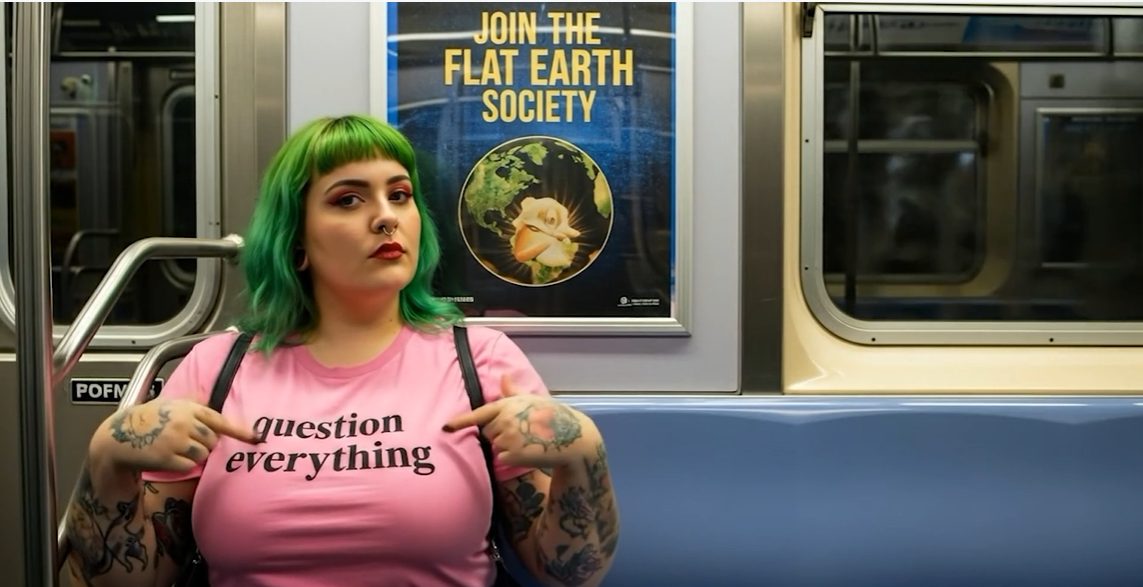
Other than the complete inconsistency in character, I have come to understand the fundamental problem with using AI to make a film. The bulk of the dataset is representative of our social bias. Even more subtle, the dataset of images is flat. A film needs a man who can turn around, walk into a room, and cast a shadow on the wall behind him. What the model has to work from is a heap of pictures, each one lying flat. So it makes up a new Mr. Buttons every time I ask. Building three-dimensional space out of flat pictures is a job with no good outcome, like asking directions and hearing, "You can't get there from here." Someone may find a road. I haven't seen one yet.
The AI world is flat.